Laura
Since I decided to spent more time in Venice, I’ve been extending my work experience from boats to other wooden objects and even restoration of paintings and sculptures. There is plenty of stuff made from wood here. One does need to keep the anti-woodworm treatment handy however.
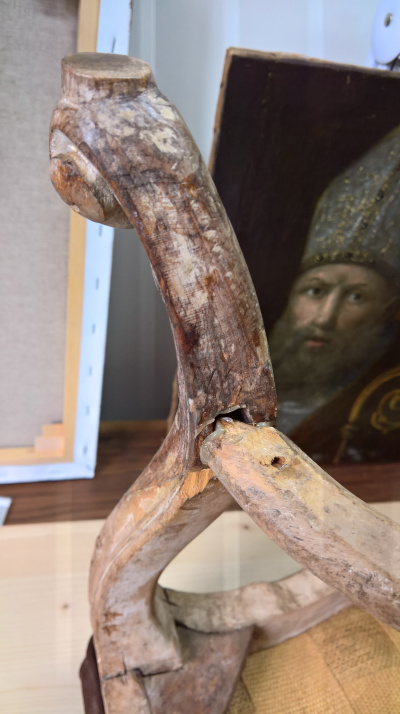
I’ve recently had the pleasure of mending and restoring an old writing desk and in the same Palazzo, there is a chair that we decide is probably Queen Anne or the equivalent local period. Based on the shape of the legs, that is. There are two chairs and they have been re-upholstered at some point. One needs a foot which has sheared off mending – one of those curled knob like feet that could look like the paw of an animal. Even though it’s a serious break in a vulnerable location, I think it can be done with the judicious placement of a screw and quite a bit of modern epoxy glue.
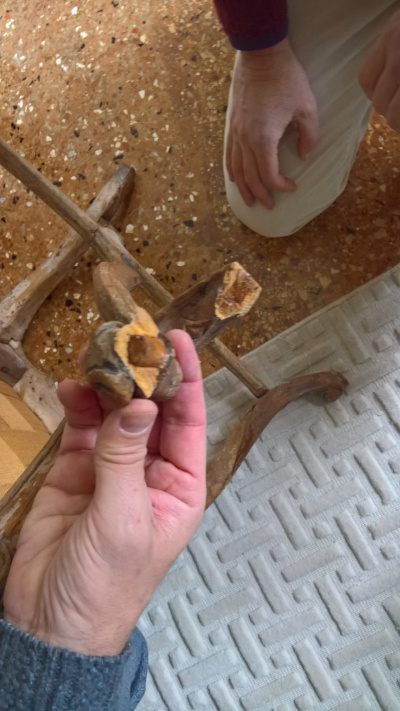
When I get round to inspecting the underside of the chair however I see quite how beaten up it is. There are braces holding together the cross pieces, loads more glue and even what looks like a completely new piece fashioned at some time to fit. My job is bigger because one of the junctions between cross bracing and a leg is completely loose. The tenon has broken and there’s pretty much nothing going into the mortice hole. The resulting instability could be what caused the foot to break. I am utterly fascinated by how this chair got broken, when, by whom and over what.
At the same time, I have been tasked with making a Felze for one of the Row Venice boats. A Felze is a canopy or cabin that used to be placed over the centre of small boats around the lagoon. They are famously illustrated in various paintings and early photographs adorning gondolas but there’s no reason they couldn’t be on any of the smaller boat designs if they were being used to carry people. I even notice a painting where there appears to be a similar design of canopy over a load of wooden planks.
The plan here though is to create something that can be dismantled and stored on the boat. The classic style that you see today is heavy and resolutely three dimensional. The 21st century gondolier obviously believes that their passengers are more interested in a 360 degree field of view than sheltering from a bit of rain or too much sun. As a consequence, you hardly ever see felze any more so this construction could get a lot of attention if it works.
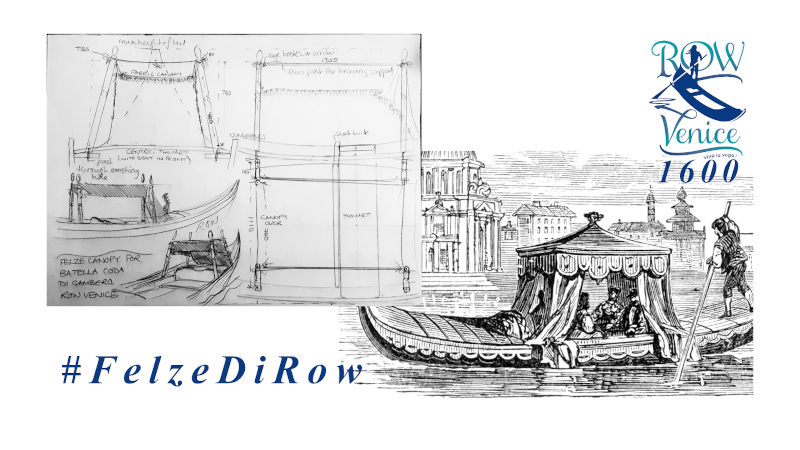
As a way of getting lots of detail into the posts that will hold the canopy up and to give the project some wholesome credentials – because why wouldn’t you – Jane, the founder of Row Venice, and I come up with an idea to reuse a piece of furniture and Jane finds a great set of six chairs that are being resold on a local trading site. The owner says they are beech even though they are stained and varnished to look like mahogany. They are indeed beech and very nice wood they are too.
Our plan is to pull these chairs apart and use the legs for posts and maybe, with what’s left we can make a nice little stool or two. So here I am, with one chair that I’m trying to fix back together again and another that is being cut into pieces.
The thing about Venice is that is full of great pieces of old furniture. It was the fashion, until very recently, for one set of Italian parents to buy newly weds an apartment and the other to furnish it. This meant that the couple, whilst set up nicely at the start of their lives, was lumbered with the tastes of a previous generation. Or maybe even the generation before that when considering the sort of parents who did this for their kids – conventional to the nth degree. At the same time, it’s very difficult to move furniture around Venice. At least it’s costly and involves carrying things up and down lots of flights of stairs, along narrow passageways, down even narrower calle (alleyways) and onto boats before repeating the whole thing the other end of the journey. And don’t forget the tide that might make the whole thing a wade through water or a precipitous drop past slimy walls.
So heavy, old fashioned but well built and often beautifully designed furniture isn’t much loved here. You can pick up some amazing items if you can move them. Jane and I even go and look at an apartment clearly being cleared after the death of an elderly relative and it’s sad to think that some of what is there might get broken up for firewood. Our six dining chairs are on the mainland however.
Back at the Palazzo, I also work on the broken chair’s pair, giving it some antitarlo (woodworm) and a polish. It is in pretty good condition , is the answer to my questions simply that someone wanted to keep these two chairs as a pair? Were they heirlooms? Did someone smash my broken chair over someone’s head in a fit of peke that they then regretted or maybe the chair proved to be a deadly weapon and it was kept as a trophy? At least three legs were completely snapped off. Did someone too heavy for the chair stand on it and caused it to collapse or did it fall out of one of the mini lifts that are regularly erected here to get things up to a top level apartment when the stairs are too narrow?
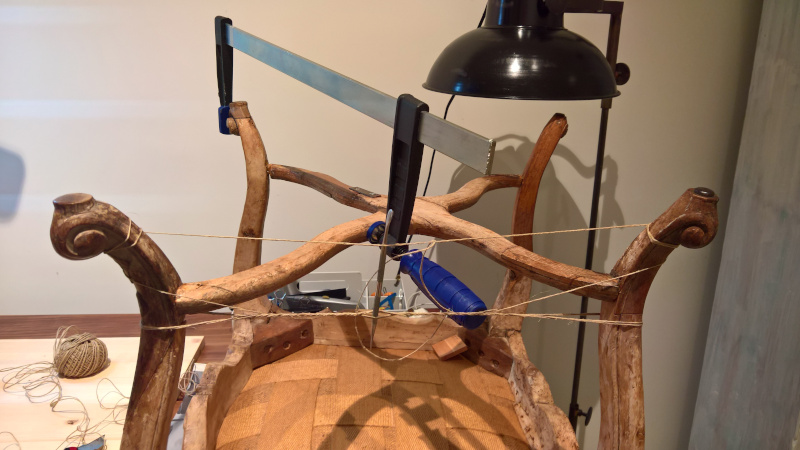
At some point someone screwed some heavy metal plates into the cross bracing to hold it together so I decide to do the same. It’s not pretty but the wood is strong and sound and it will make the chair safe to sit on. This is quite a serious dilemma for me. Boats mustn’t sink but ornaments mainly just come with aesthetic demands. Realising that someone might have gone crashing down onto their coccyx already whilst using this chair puts quite a lot of pressure on my woodworking skills. The owner assures me that it will be mainly ornamental but one can never guarantee that someone won’t grab it to replace a bulb in the ceiling one day. Although the ceilings of a piano nobile (fancy first or second floor of a Palazzo) are a bit high for chair standing. The point is, whatever it’s fractured past, this chair, for now at least, is a keeper.
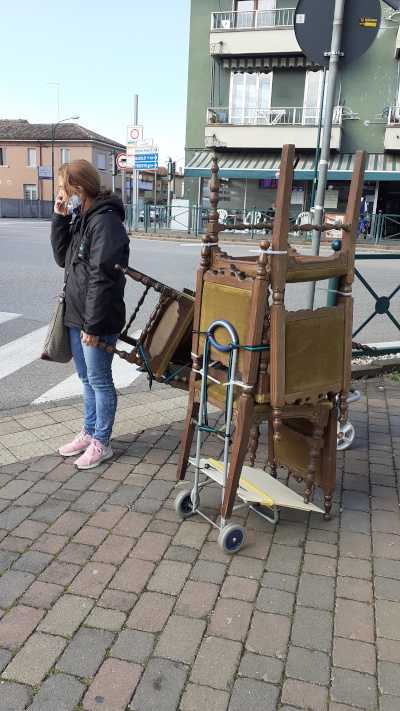
The dining chairs have a different fate but first we must get them to the workshop we have been lent for the duration in Cannaregio. From the mainland. Or as I love to call it by its utterly authentic and original name, if you’re a Venetian – Terra firma. Jane and I discuss how close the canals of Compalto go to the sellers house. It looks like entrances are closed up and the tides are so low at the moment that there’s a good chance the main channel will be too silted to navigate. We decide to go by bus instead, both armed with a shopping trolley. The seller looks at us like we’re mad. But Venetians often don’t own cars. They own boats instead.
Somehow we get three chairs each tied with bungies and zip lock ties to our respective trolleys. We trudge to the bus stop looking like strange wood fetished bag ladies, particularly me with my sparkly rucksack hung on the front of my chest to get it out of the way. The bus driver takes one look at us and drives straight past. Bastardo. What are we going to do now? I do love a problem to solve however. We could wait for another bus but they’re every twenty minutes and the reaction might be the same. On the road, I’m not sure they’d fit in anything other than a white van. It comes to me that we’re actually not so far from a marina on the edge of the lagoon. Can we walk there and be met by Jane’s hubby, Luigi, in her little motorboat. It turns out we can. It also turns out that a boat can take much more than an average saloon car and it can drop you off much closer to your final destination. On the way we even see some friends training for the national standing up rowing championships in aluminium boats. Yep, you heard it. Aluminium. Strange beasts.
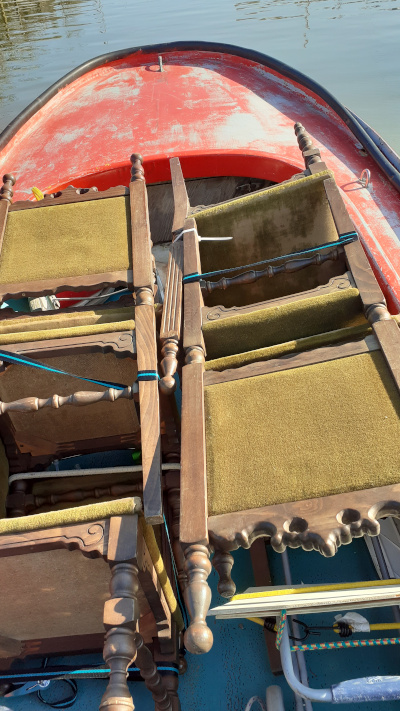
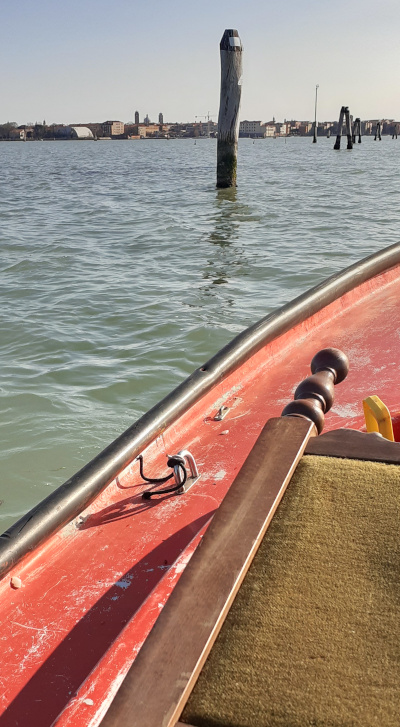
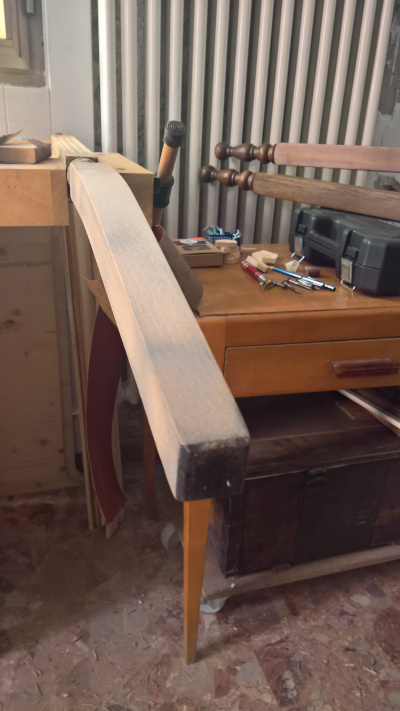
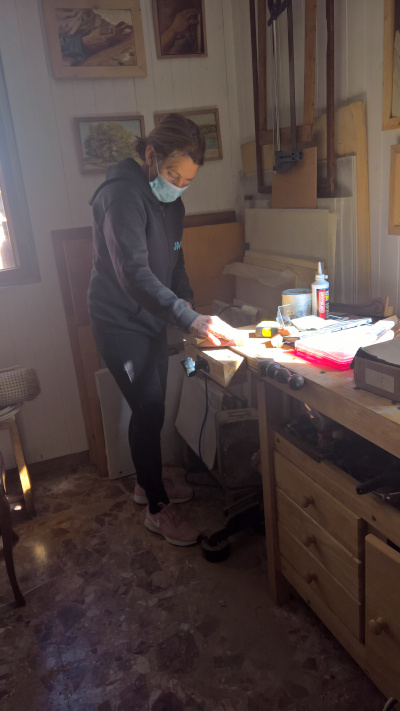
A couple of days later we are back in the workshop and chopping off legs, sanding and making the shape fair. I am teaching Jane some basic woodworking principles. I’m not sure she knew what she was letting herself in for but then, I could say the same about her teaching me to row so now we’re even. The concept of fairness in a physical structure is an interesting one. It’s both practical and aesthetically pleasing. Actually I think the former morphed into the latter. As with many things. It is particularly noticeable in a curve. Curves work best if they are smooth and progressive – something I’ve just learned about and need to study more.
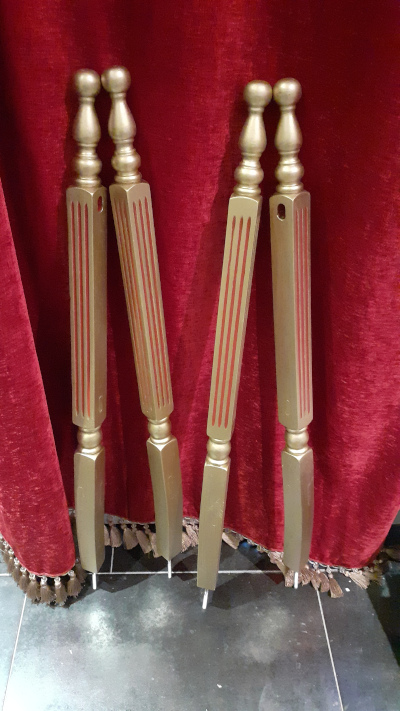
It makes sense that you have even stresses and something that flows through air or water well. We just seem to know instinctively if something is not fair, looking ugly as a consequence, even if we don’t know why. A wood plane is a great way to make a piece of curved wood fair. Next we have to sand, paint and cut the posts to the right length. Everything will be held together with a fabric canopy but we decide maybe a bit of cross bracing won’t harm. I can’t wait to get these simple post structures onto a batella coda di gambero and see if they work. We are using existing bracketed holes in the gunwhales of the boat but I wonder what they used to do originally to lock the felze to the boat. A heavy wooden one might have stayed in place but many of the ones I look at in paintings look much like my design – a kind of trellis covered in fabric. I can’t imagine they left these completely subject to the random power of a gust of wind. If we get it right however we will parade up the Grand Canal on the 25th March 2021. The inauguration of the founding of Venice in 421. #Venezia1600 has finally arrived and I really like this plan to celebrate it – looking back, reusing the present and designing for the future. Indeed, sort of what I did with the broken chair. I think there is a kind of fairness in both and that is pleasing indeed.
To Be Continued….