Laura
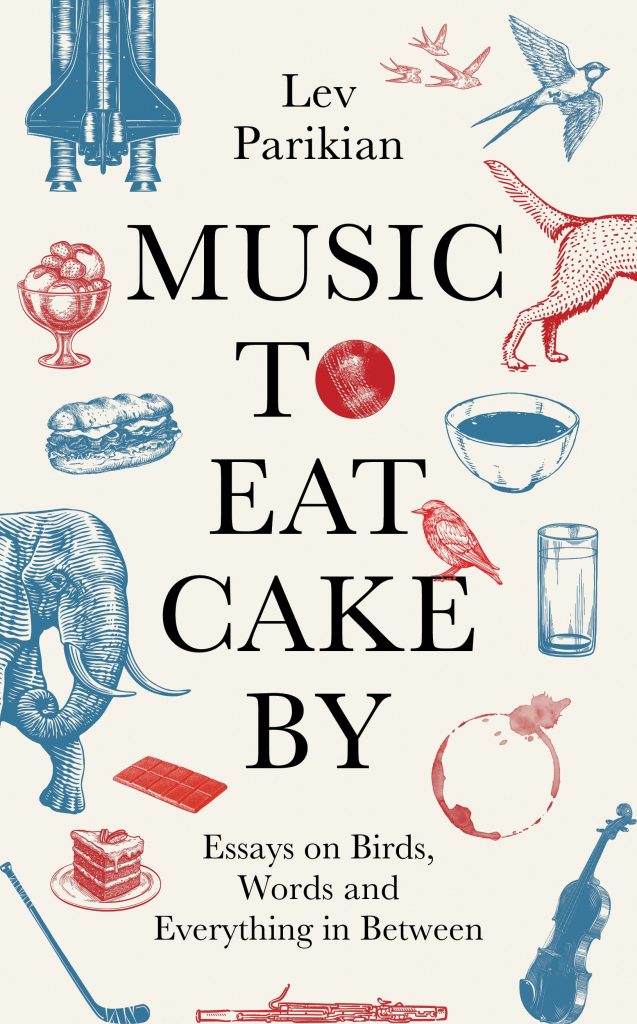
This is a guest blog by Lev Parikian whose new book Music To Eat Cake By: Essays on Birds, Words and Everything in Between will be released on 12th November 2020. You can find details about the release at his website here. I know he would love you to order from a local bookshop if you can and most of them these days will oblige. By way of disclosure, Lev is my brother-in-law. He is also bloody brilliant and I thank him for being the first to contribute directly to my nascent creative community.
Music To Eat Cake By: Essays on Birds, Words and Everything in Between
There are many ways to write a book. Some people start at the beginning and just carry on till the end. Others might adopt a scattergun approach, writing the bits they’re ready to write and piecing it all together bit by bit. Still others draw up complicated charts and tables with loads of arrows and circles and things linking it all together in ways that look super complicated but no doubt make sense to them. The details of the writing process – much fetishised by those trying to get to the bottom of the craft – are, in a way, irrelevant.
But one thing on which everyone is agreed is this: you need an idea.
I’ve never had a problem with ideas. They come to me pretty much constantly. The difficulty lies in sorting the good from the rubbish. And so it was with my idea for Music To Eat Cake By. I had the idea at 3 a.m., and like all ideas you get at that time it was obviously genius. Five hours later, in the cold light of day, it was clear that I was mistaken: it was garbage.
Thankfully, when I ran it past my publishers Unbound, they agreed it was nearer the former.
The idea, taking advantage of Unbound’s unique position as a specialist crowdfunding publisher, was this: as well as asking people to help fund the production of the book, I would ask them to furnish me with the ideas for its contents. The result is a book of 40 essays (starting long, and getting shorter in increments) on subjects as wide-ranging as The Art of the Sandwich, Melancholy, The Bassoons in my Life, and (and this is either my favourite or most hated – I can never quite decide) The Intrinsic Link Between Chocolate, The Wombles, and Musical Theatre in Post-Millennial Britain.
And plenty more.
Unbound’s founding tenet is that in an increasingly homogenised publishing world they wanted to put more control in the hands of readers. The beauty of the crowdfunding principle is that only the books readers actually want to read make it to publication. Music To Eat Cake By takes this principle to the next level. The logical conclusion would of course be to ask the readers to write the book themselves, but even I baulked at that.
Here is one of the shorter pieces from the book, suggested by my friend Andrew Ross. I hope you enjoy it.
The Language of Swallows
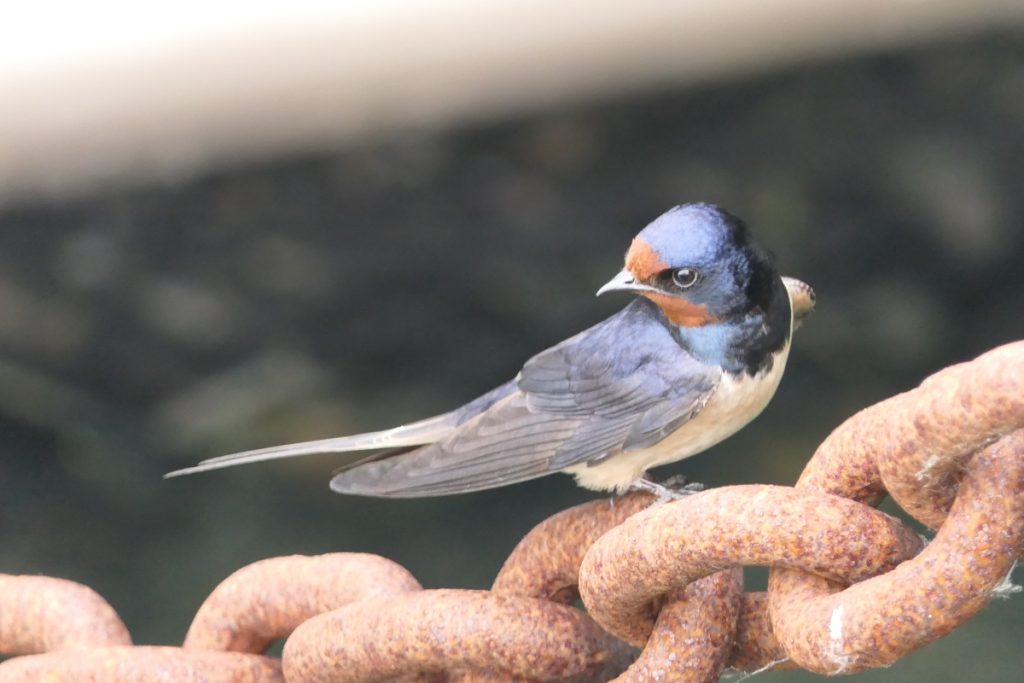
They come to us from far-off lands, dipping and swooping with an elegance that belies their strength and stamina. Metal-blue backs with a satin sheen, creamy underparts, dark red around the forehead and throat; and then there’s the tail, its slender forked streamers lending the bird a hint of the festive. An encounter to cheer, to thrill, to reassure us that summer, if not actually here, is at least icumen in.
And along with this brazen beauty comes the sound – a fast chattering, not all sweetness, but undercut with a slightly guttural quality. It’s not unlike the sound you get, now largely and sadly lost to humanity, when you press play and fast-forward on a tape recorder at the same time. Within this twittering there might come an occasional croak, swooping slightly upwards, and then a rattle, like a briefly agitated Geiger counter. Slow it down and you find yourself in a surreal and weird sound world, not unlike an echo chamber, but along with that comes a form of enlightenment. Previously unheard phrasings and shapes become discernible, subtleties we’re too slow to hear at full speed – that’s our problem, not the swallow’s.
It has a lot to say, the male swallow, and says it often. ‘Come and mate with me’ is the predominant message, but even when the bird has successfully paired off, the song continues. ‘Hands off, she’s mine’, perhaps.
It’s uplifting, that sound, enough to make me stop and look and listen. The French, pleasingly, give it the same word as for the babbling of a brook: gazouillement. The poet Abraham Cowley begged to differ.
Foolish prater, what dost thou So early at my window do?
Why thy tuneless serenade?
…
Cruel bird, thou’st ta’en away
A dream out of my arms to-day
While I can always find a modicum of sympathy for the sleep-deprived, these words seem unnecessarily harsh. The swallow’s voice might not have the deep and resonant poetry of a blackbird’s, but there is beauty in it, and irre- pressible good cheer. And if it lacks a melody discernible to human ears, then it’s merely joining a very popular club – birdsong largely defies our attempts at musical notation, and the situation is even worse when it comes to finding equivalents using words. There is no birdsong translitera- tion lingua franca – one person’s tswit is another’s tviiit is another’s sweeeet – and matching those words to the sounds we hear is notoriously difficult.
As well as the male’s beguiling song, swallows of both sexes make a range of sounds, variously transliterated as tsink, chur-chur, siflitt, twhitt, tswee-wit, flitt-flatt, feeta-feet, wid-wid, waeae-waeae, dschid-dschid, flü-flüh, dewihlik, zibist, zetch, tsä-tsä-tsä-tsä, weer-weer, hubba-hubba.
To our ears, these noises are part of the rich aural panoply of nature in spring and summer; to a swallow, they’re everyday communication.
‘Hello’, ‘Well heLLO there’, ‘Come here’, ‘Go away’, ‘Anyone fancy a bit?’, ‘Don’t even think of coming any closer’, ‘Stay together, children!’, ‘I am enjoying this bout of sexual intercourse’, ‘Come on, eat it, it’s just flies and you always say you like flies’, ‘Watch out – there’s a human about!’, ‘SHIT! CAT! CAT CAT CAT CAT CAT!!!!’
And if that paragraph makes me guilty of anthropomorphising, I am, on this occasion at least, backed up by research, which tells us that these, more or less, are the things that swallows tend to say to each other.
And if we derive pleasure from observing their chattering, twittering, swooping, gliding and diving, then so much the better.