 Laura
Yesterday a friendly elderly gentleman, who lives near me and always wants a chat, stopped me in the street to warn me that there would be an Acqua Alta in Venice today.
Acqua Alta.
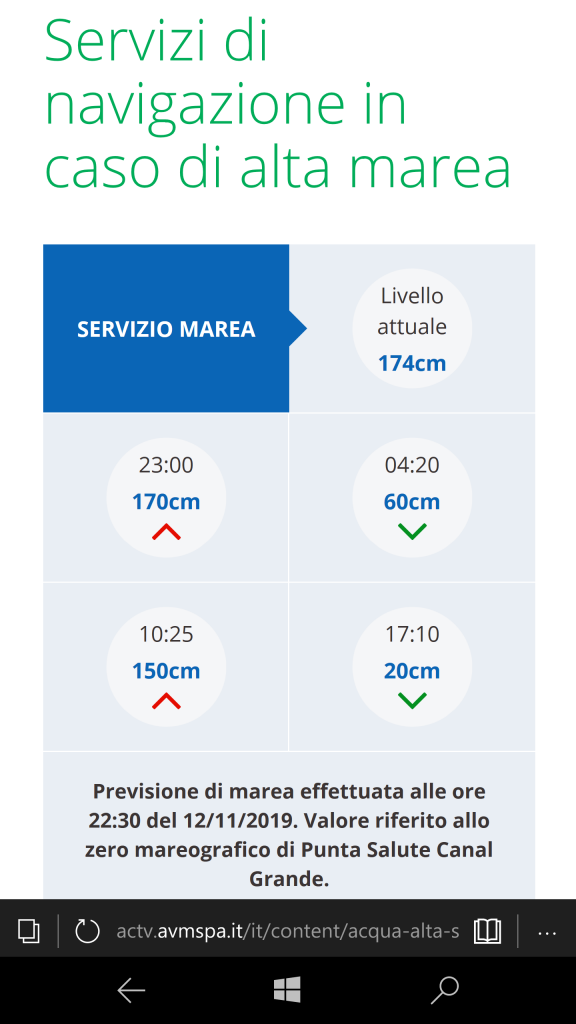
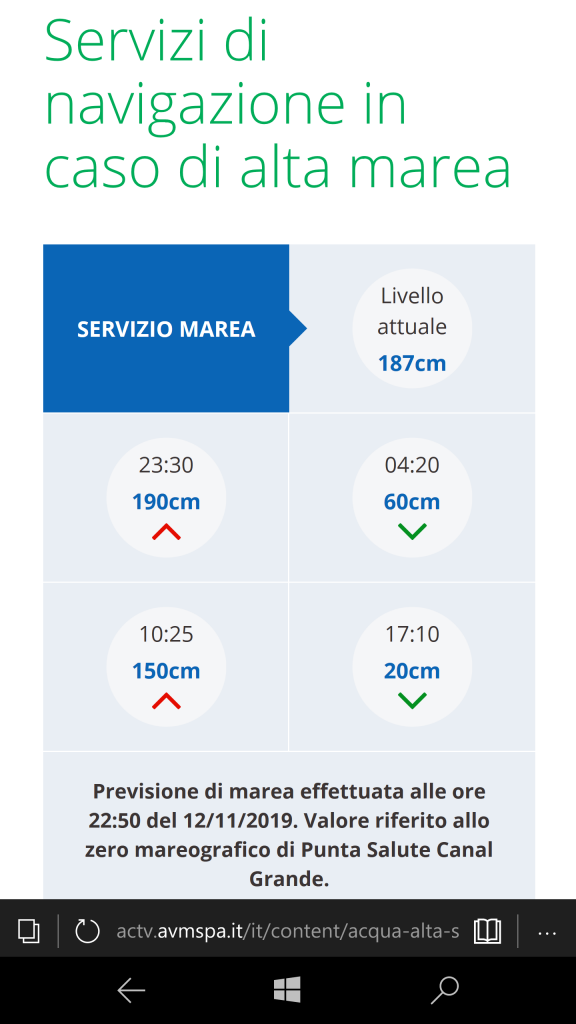
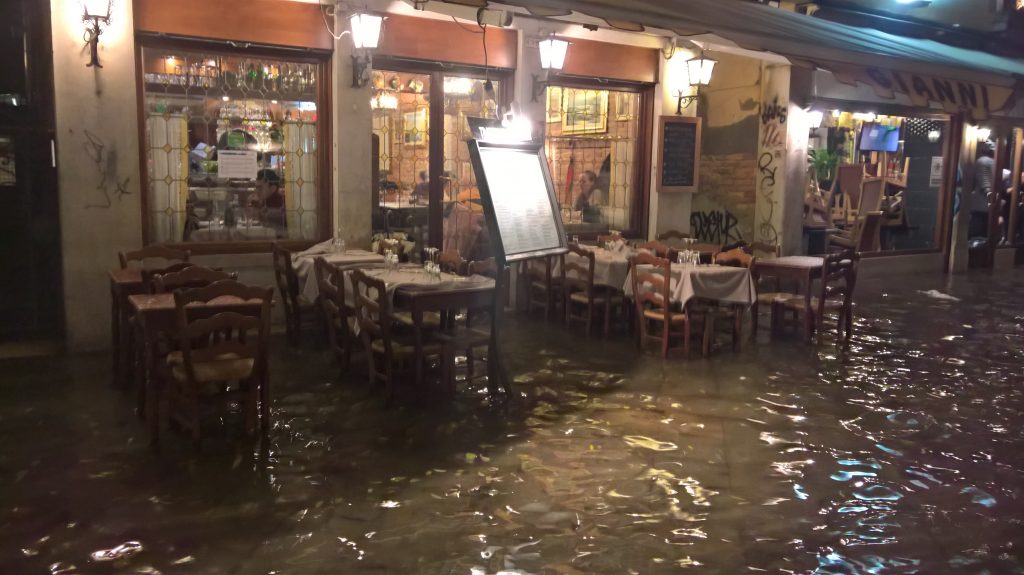
All he had to say was those two words. Acqua Altas are a part of the fabric of Venetians’ lives. They know instinctively when to take their boots out with them and which is the best alternative route back home. I imagine my neighbour was in his 20’s when the Acqua Grande of 1966 devastated the City. We both experienced last year the event that, in height, was only 7cm off that tide of 194cm. In fact, whilst the Acqua Alta of 12th November 2019 did a lot of damage and two people sadly lost their lives as a direct result of the flooding water, it was nowhere near such a catastrophe at the previous Acqua Grande, for a number of reasons. Today the city has well insulated and maintained water, electricity and gas services so there were no power or water cuts. The warning system, whilst caught short about the absolute peak of the tide, still provides comprehensive early and detailed information for anyone that needs it. And in ‘66, the water remained in the city without going down for a number of days because the conditions trapped the extra volume inside the lagoon and the low tides, such that they were, didn’t give enough time for slow moving water to drain out.

I lift everything up that is likely to get damaged in my ground floor apartment, move the plants in the courtyard, put the paratie gates – kind of mini personal versions of Mose – on the front and back door and wait for the sea. The calle outside my apartment is at about 120cm and if there’s a sudden change in the wind like last year, there’s always the potential for much higher water than the forecast of 135cm. Then I read that they are going to try the flood barrier.
The thing that is difficult to understand about Acqua Altas is that they’re normally very brief affairs with the dangerous peaks only lasting minutes. An hour or two at most. Never the less, it’s a big deal that the Centro Previsioni e Segnalazioni Maree Protezione Civile announce that the Mose flood barrier, that lifts in a series of pontoons from the bottom of the sea at the Lido, Malamocco and Chioggia lagoon mouths, will be triggered for the first time in real sea state conditions.
The gates completely block the flow of water into the lagoon once they are fully up (although I wonder whether the design means they can leave parts open to regulate the flow of water now and then). An article I read says that they currently block all shipping from entering and leaving the lagoon but I since read that three locks have been constructed. There has to be an arbitrary forecast height for the tide when the barriers are deemed necessary and it was announced this week that level will be 130cm above the official mean sea level at the Punta Della Dogana, in front of Piazza San Marco. 135cm fits the criteria.

Yesterday I also jumped over the last hurdle to get my residency permit to remain in Venice after a very nice man from the council came round to check that I was actually living at the address I had put on my form. I had been waiting in for about two weeks for the ‘surprise’ visit and, in fact, he arrived on a different day than I had expected. Before he left, he told me the history of cats in Venice.
When the trading ships that made the city so famous used to crowd the rivas, a word which in those days meant the shorelines, they would bring plagues of rats along with the riches of the orient. Plague meant not just the nasty bacteria that legend says brought the plague to Europe but also the sheer numbers of an animal that is well adapted to live off the excess food that humans tend to throw away. They also sometimes get into supplies of future food. I can just picture the ancient authorities trying to find ways of sealing up the huge grain store that used to be around the corner from me, not from sea water but from rats.
Of course the best solution is to introduce a predator that can control the rat population and cats were encouraged to go to work. I love the Lion of Venice, that regal motif stamped all over the city, but I also like to think that some of the iconography is in worship to the cats that rid the city of the rats. Of course, as my friend explained, there came a time when the ships no longer came to Venice. The rats diminished in number and now the cats – particularly the population of feral cats that had established itself in places like the Arsenale and nearby Giardini – became the peste, the plague. Kind hearted ladies fed and housed the cats but in the end, a programme of castration was adopted and slowly the population of cats diminished. Until the dawning realization came quite recently that the rats had never been eradicated and guess what’s become a problem again.
Everything I read about the lagoon within which Venice sits, amplifies the fragile balance of it’s eco system. Change one thing and there is inevitably unintended consequences for something else. In 1966, the vegetation, that normally forms all over barenes in the shallow water of the lagoon, trapped the flood water. Now the deep water channels, dug for petrochemical and cruise ship shipping and more recently excavated to regularize the coastline for the construction of the flood gates, scour the lagoon and allow the water to move dangerously fast. My rowing friends talk of the danger of trying to row past one of the Porta openings that now proudly host the currently budgeted 5.5billion euro barrier.
The original deep water channels were dug by the Austrian colonising navy at the beginning of the 19th century. For five hundred years or more, before that, the Venetians successfully developed a very balanced eco system that let just enough silt into the lagoon, washed down from the Dolomites, to make navigation something only they could understand but not enough to block the city up completely, turning it into a second (abandoned) Torcello.
The system probably didn’t work quite that perfectly but certainly, the historic Venetians adapted and altered the lagoon just as much as the current ones are doing, when they diverted the main rivers, that flowed into the area, north and south of the lagoon. Of course, in the end, the city elders pretty much handed the keys over to Napoleon when he came knocking at their door at the head of a French army in 1797. By that time, to all intents and purposes, they were already slaves to the trade of tourism. Venice was the ultimate party city and opened it’s doors to the world. How could it shut that revenue off? How could it do that then? How could it do that now? The unintended consequence of more zoonosis as humans increasingly push up closer to the natural world produced a virus that has answered the last question. The city was closed and Venetians have, for most of the year, got what they often talked about and longed for – Venice for the Venetians. Today they also got a city that is safe to live in. If your home or business sits above 130cm that is.
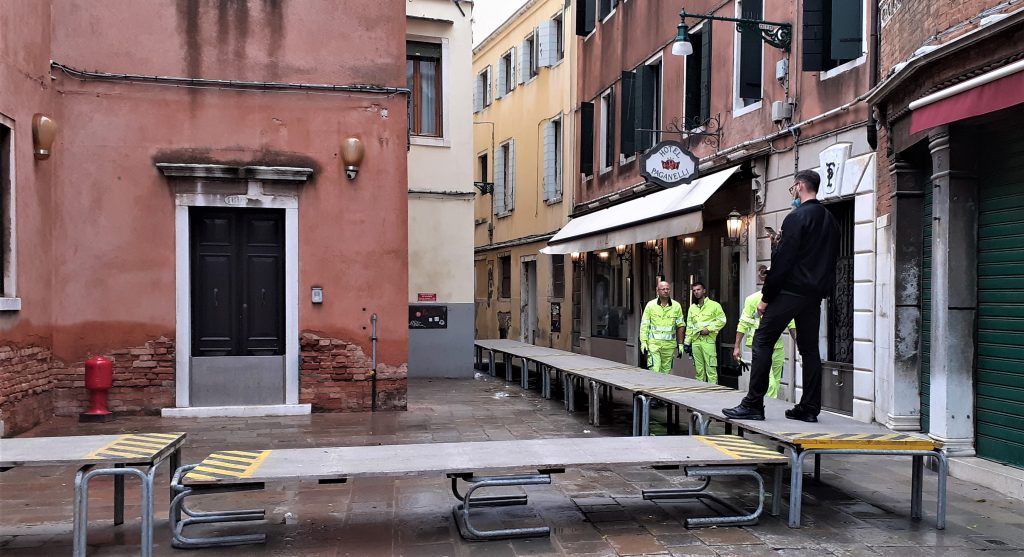
Of course there is a scandal around the money spent on Mose. However the bulk of the investment will have gone on the many thousands of people who have and still do work on the project, enriching the city and it’s environs in a very different way from visitors on cruise ships. Mind you, I can’t help but think about the men whose job it is to put out the passerele (or raised walkways) every time there is a high water and sometimes take them away again before they float away when the water gets to high even for their wooden and scaffolding structure to work. The city is usually committed to providing this service at many low lying but important locations from September to April. Today the success of Mose suggests this will no longer be needed although there will still be those high tides from 85-130cm that put a decent amount of the city underneath paddling height water. Will businesses and residents that live below this level start to demand that the gates get closed more often? At lower tide levels? What will even the capping at 130cm and the subsequent much lower tides inside the lagoon cause to the ecology of the area?
I sit at home looking at pictures of a row of huge yellow bricks pushing one long brutal edge up above the waves. The announcement is made that the sea inside the lagoon has stabilized at 70cm whilst outside, in the Adriatic, it is about 120cm. I think about the clever minds who have made this mad plan work – raising the whole coastline so that there are no thumb holes in dykes to open up, building special platforms to work on in difficult conditions and now, working out exactly when to raise the gates so that the flow of water stops at a comfortable 70cm. They presumably also worked out how and when exactly to lower the gates again to ensure that there isn’t a reverse tidal wave out into the sea as the waters go down again.
When the infectiousness of Sars Cov2 started to cause countries to shut their economies down, cleverer people than me tried to work out the consequences – for gross domestic product but also for the heath and wellbeing of populations, beyond that of the disease Covid19. The complexity of one decision, one choice, one action on everything around it is beyond imagining. The butterfly effect indeed.
They engineers working on Mose hopefully also worked out what happens at the limits of the barrier. Mose can only work if all the lagoon edge has been lifted to the same level of protection but somewhere along the coastline, there is a place that is lower than the highest level of the sea defences. Presumably the decision has been that it is all right for these regions to flood like the designated flood plains either side of the Thames Barrier in London. But a huge amount of water will potentially be held outside the vast lagoon area and will it create higher flooding in neighbouring regions that hadn’t actually been planned for? I think about those clever minds and hope they’ve been flapping virtual butterfly wings.
Mose rose today.
I was anxious yesterday and yet today I walk out of my door to streets only wet from a bit of rain. If the flood barrier continues to be effective, how much of the city will never be completely soaked in salt water again? How many properties like mine will suddenly have a viable economic value again. Many of them have been converted into AirBNB or similar ventures. Could the whole ground level of Venice be converted into accommodation for the tourists while the locals live happily in their stunning Piano Nobiles? Then again, where will the tourists come from when the airports are closed? Will the lagoon suffer from the interruption in flow of water from the sea or will it benefit from the absence of people?
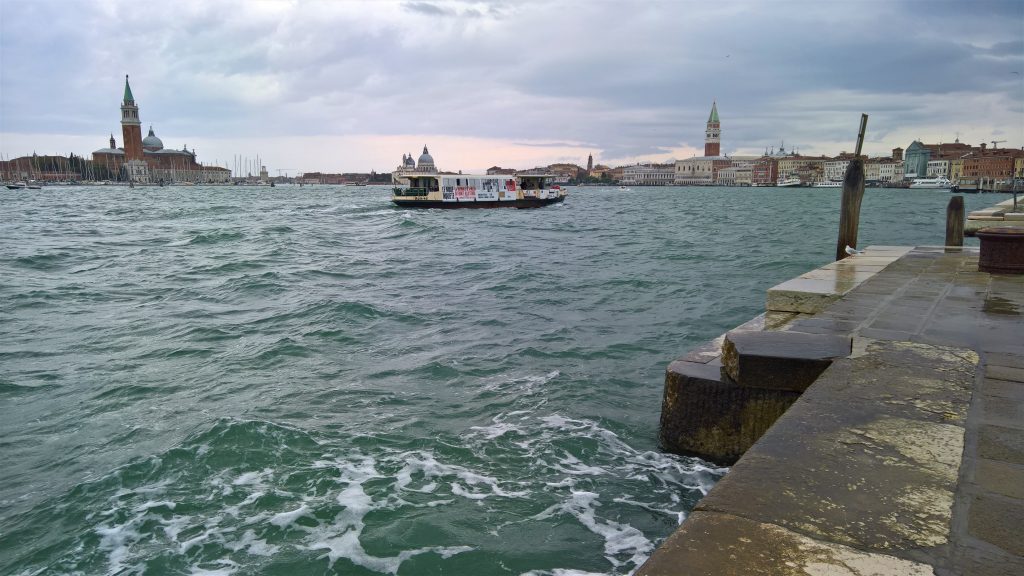
I stand on the Riva Dei Sette Martiri, with dry feet, when the waves should be washing across the stone flagging. Intending to write about how I feel, as I look out across the Bacino San Marco, I read about other geographical features causing heavy rain to flood areas in Southern France and Northern Italy to devasting effect.
Mose was designed and enacted to protect real estate. Extraordinarily beautiful real estate, possibly the most beautiful real estate in the world. Of course livelihoods will also be protected. People will live with less stress about the potential for their home or their business to be damaged or destroyed. On the flip side, life in Venice has gone on for 1600 years in harmony with the water and with no recorded instances of mass death from water or the actions of the sea. Whatever the consequences, unintended or not, of this successful operation today, the city will endure, the people will thrive, nature will probably adapt. How will we reflect on this day in the future. The men who’ll most likely lose their jobs, putting out the passerelle, will definitely curse the date. Maybe the heinous disposable plastic wellingtons will disappear although one wonders what will become of the stock.
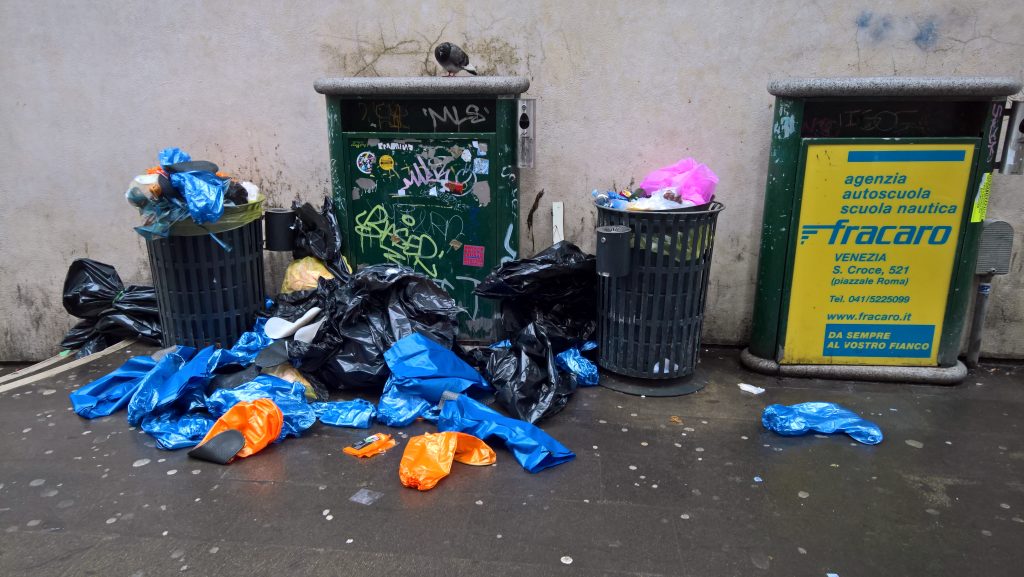
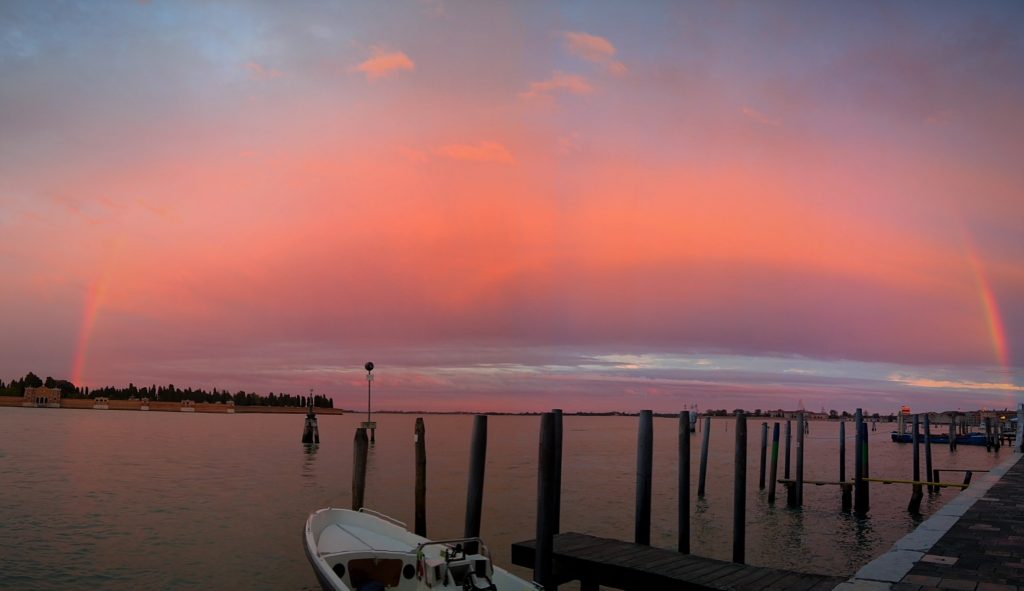
Most of the things we’ve created over the last two hundred years or so have made our lives immeasurably easier. Mose rising is an incredible achievement that will make Venetians lives easier. It’s a moment of change. But what will my old friend find to talk about instead. To be fair, as the sun sets on this momentous day, there’s a stunning rainbow over the lagoon.
You can find a few more Acqua Alta photos from November 2019 here:

[…] Unintended Consequences […]